
On X, engagement is visible. Conversion is invisible.
That asymmetry is exploitable, and cheap to produce.
We paid $110 to document exactly how.
In early February 2026, we reached out to a crypto promoter we knew from a previous token launch. We needed distribution for a new product. He promised 300 to 500 subscribers per month, with 100 to 200 "participating and spending fully."
We said yes. But not for the reason he thought.
1. The Pitch
The conversation started on February 10th. We knew this guy from a token launch a couple of years back. He ran a network of accounts across X and Telegram, doing promotional work for crypto projects.
We reached out. The Signal Engine was new, the X account had barely any presence, and we wanted to explore whether organized promotion could produce real subscribers for a paid service.
We asked the direct question: Do you have real followers? Not your army that you use for different "spread tasks". People that can spend money?
He didn't want to be an affiliate. He wanted a job. A partnership. When asked for a strategy plan, the response was a copy-pasted paragraph about "consistent promotion, real user growth, and measurable results."
When we pushed for specifics (pricing, targets, anything concrete) the strategy stayed vague.
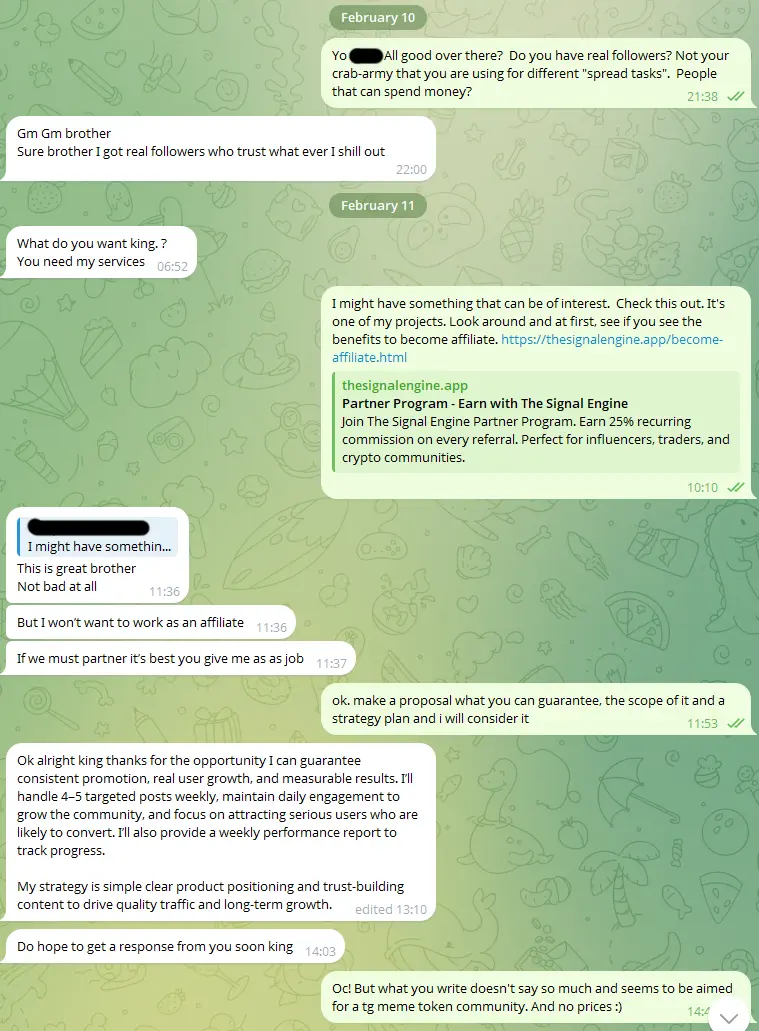
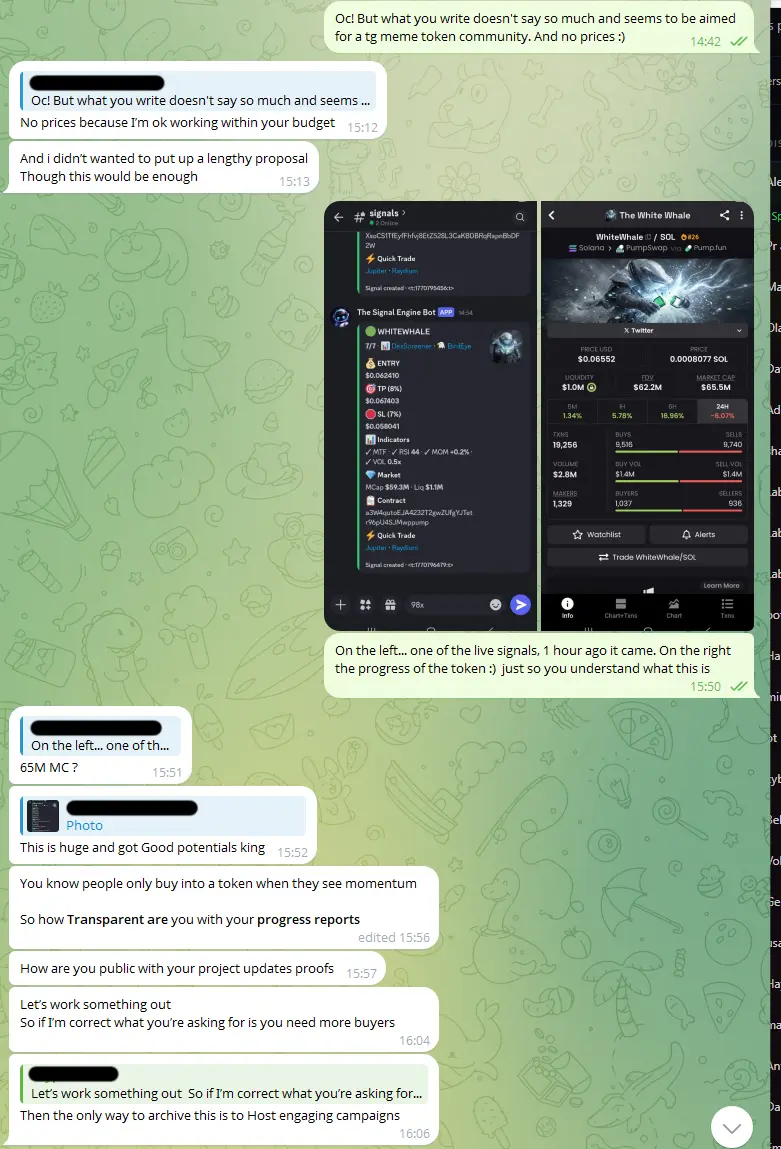
The negotiation continued. We made it clear: this is not a "get that meme to pump" project. We need subscribers. People who pay $39-69/month for a trading signals service.
We asked for a number. Just an estimate. The answer was bold:
300 to 500 subscribers per month. We noted the number.
2. The Silence
The deal was made. Then, within a day, the first sign appeared.
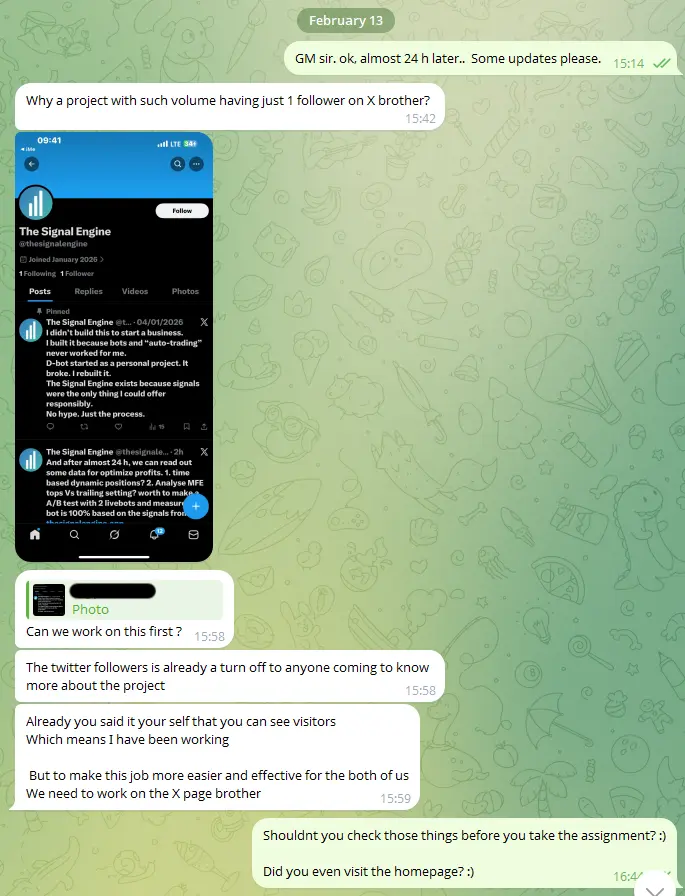
On February 13th, the promoter sent a screenshot of The Signal Engine's X page. One follower. He had a point:
Did you even visit the homepage? :)" 16:41
Fair point, honestly. The project was brand new. But instead of working with what was there, he immediately pivoted to selling us 500 "real and engaging" X followers for $150.
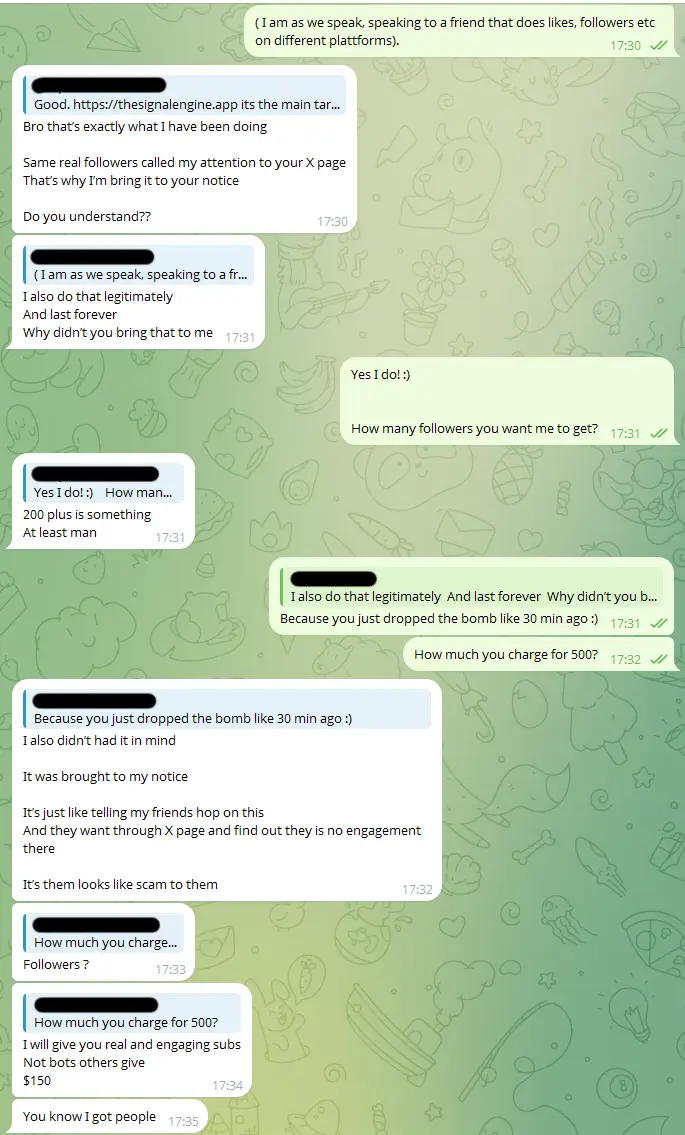
We said no. Then silence.
Ten days passed. No subscribers. No traffic. No activity of any kind. The promoter had created a Telegram group called "Signalengine Enthusiasts" and added approximately 20 accounts. That was it.
Twenty accounts. Here's what they actually were:
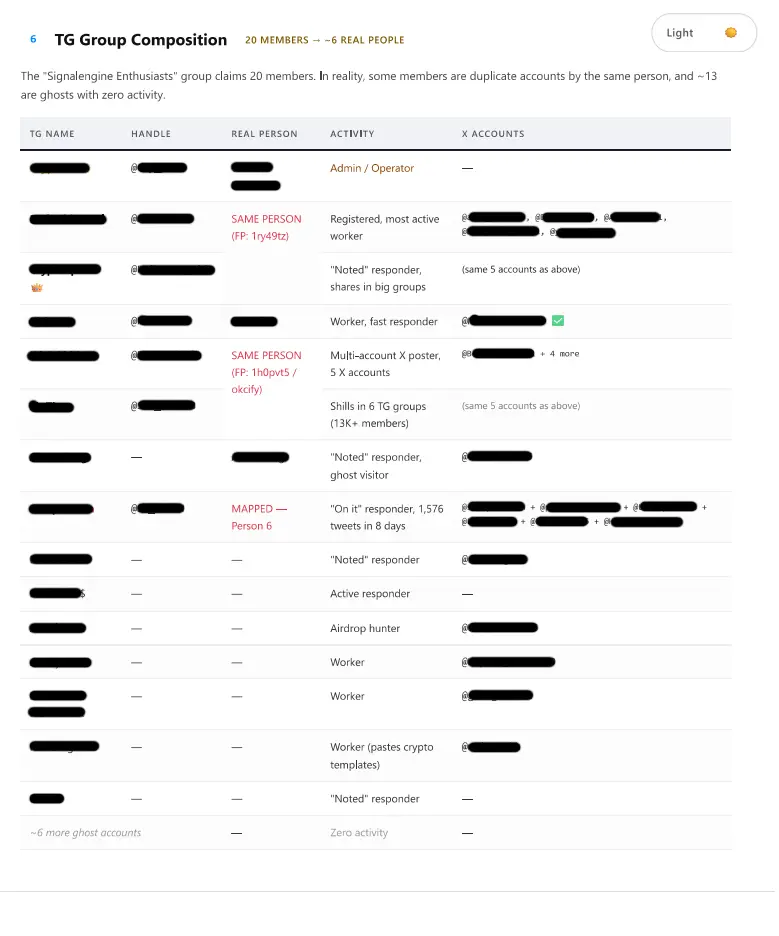
Six real people. The rest were duplicates, ghosts, and accounts that never posted a single message. This was the army that was going to deliver 300-500 subscribers per month.
On February 21st, he came back. No results. Just a request:
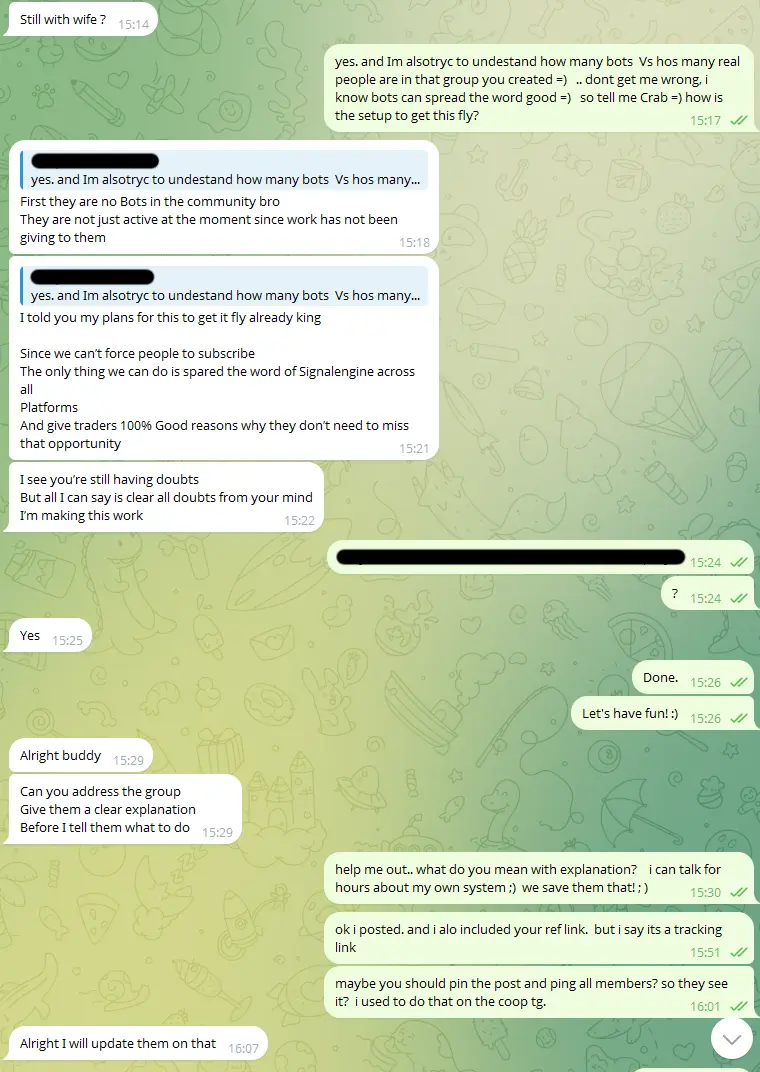
He was telling us, straight up, that he couldn't do anything alone. He needed to bring in workers, and those workers needed to be paid. The guy who promised 300-500 subscribers from his own network was now admitting that network doesn't move without cash.
Read that again: "They don't get serious except being giving something."
That "100 to 200 people" from the initial pitch? Not exactly a solid claim. Could we have paid for 200? Sure. We'd have gotten a bigger group doing the exact same thing. More members, more money, same outcome. These guys know how to create activity. They don't know how to reach the right demographics. And activity without the right audience is just noise.
This is the operating model. Not an audience. Not followers who trust a recommendation. A group of paid workers who click when paid, and do nothing otherwise.
3. The $50 Experiment
The promoter had already received $60 upfront. Now he wanted another $50 to recruit 7 "shillers" at $5 each.


We asked the obvious question: "What are they going to do? Chill it?"
The answer was telling:
We sent the $50.
Not because we expected subscribers. The expectation of results had died ten days earlier.
We sent it because we had been building something during those ten silent days. A device fingerprinting system that identifies individual hardware through browser-exposed signals: canvas rendering, AudioContext waveforms, font enumeration, floating-point math precision. The $50 wasn't for marketing. It was the price of a real-world test dataset.
4. The Instrument
While the promoter was idle, we deployed tracking infrastructure across every page of the product:
- Full device fingerprinting (20+ signals)
- Behavioral telemetry
- Session correlation across IP clusters
- Canvas, audio, font, and math precision signatures
- Battery discharge pattern analysis
- Gyroscope and motion sensor detection
- GPU renderer identification
- Timestamp correlation with social media posts
The system could distinguish between automation, emulation, and genuine hardware. It could identify when multiple digital identities were operating from the same physical device. It could correlate a page visit at 13:17 UTC with a Telegram post at 13:18 UTC and determine, with hardware-level certainty, that the same phone produced both.
All we needed was for them to visit the website. One page load. That's it. The fingerprinting system would capture the device signature and the puzzle would start assembling itself.
So we posted the "How It Works" link in the chiller group. Framed it as onboarding: "Before we get started, I'd recommend checking out the 'How It Works' page so you understand what The Signal Engine actually does." Helpful, reasonable, totally normal.
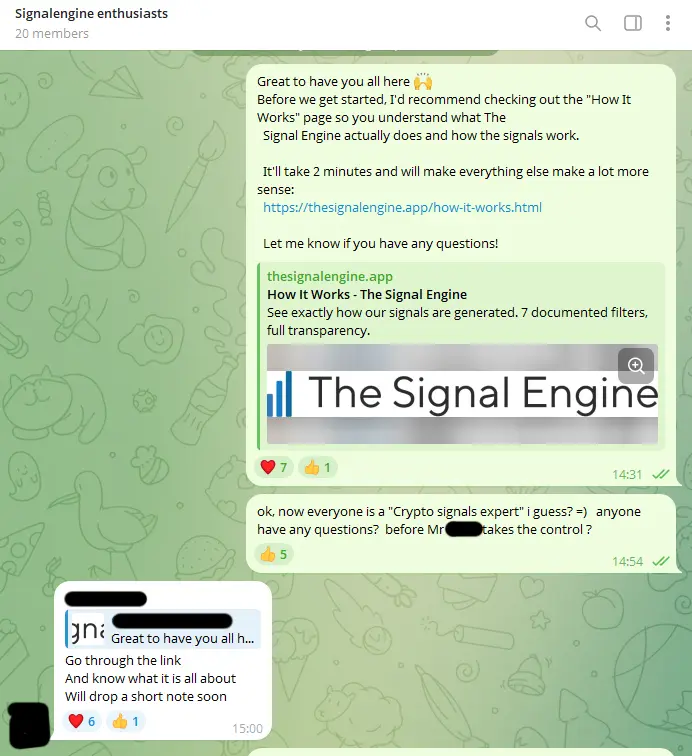
Every member who clicked that link handed us their full device signature. Canvas hash. Audio rendering profile. Font enumeration. Math precision artifacts. GPU renderer. Battery status. Screen dimensions. And more.
First question: are these real people or an automated farm? If the fingerprints had come back as headless browsers or rotating VPS instances, the story would have ended there. Just another bot operation.
But they were real. Six distinct devices. Real phones with real batteries, real gyroscopes, real GPUs. That was actually encouraging for a moment. Real people meant there was at least a possibility this could somehow work.
Twenty-four hours of tracking and puzzle-solving later, the picture was complete. Six real people, operating dozens of accounts, writing for empty rooms. Not a single person outside their network had clicked through. They were performing for each other.
5. The Activation Event
On February 21st, traffic increased sharply. Not gradually. Not diffusely. Sharply.
Within a 24-hour window, 87% of all visits in the 30-day reporting period were recorded. The distribution curve resembled a spike, not a slope.
By February 23rd, the activity had collapsed. The "20-member group" had produced its full output in a single day.
6. The Geography Problem
Initial metrics suggested international interest: multiple cities, multiple countries, apparent US engagement.
On closer inspection:
| Origin | Finding | Verdict |
|---|---|---|
| United States | All traffic from 17.x.x.x - Apple link preview crawling (iMessage, Safari) | Automated |
| China | Single session with SwiftShader GPU - emulated environment | Emulated |
| Thailand | Internal testing - confirmed via RTX 3080 fingerprint | Internal |
| Nigeria | All remaining substantive activity | Real devices |
The apparent geographic diversity dissolved under examination. The remaining substantive activity originated from one country.
7. Real Devices, Absent Intent
Crucially, the Nigerian sessions were not bots.
These were real phones held by real people. Yet across all sessions:
The traffic was real. The phones were real. The people were real. But none of them had any intention of buying anything. That's economic misalignment, and it's the part that metrics dashboards don't show you.
8. Identity Fragmentation and Hardware Convergence
The most revealing observations emerged at the fingerprint layer.
Distinct (Many)
- Usernames
- Telegram accounts
- SIM providers
- IP allocations
Identical (One)
- Audio rendering signatures
- Canvas hashes
- Font enumeration profiles
- Math precision artifacts
Hardware entropy is difficult to fake. AudioContext signatures and floating-point precision behaviors derive from physical chipset characteristics.
Different digital identities. Same physical device.
The "20-member" Telegram group was actually 6 real people operating 14+ Telegram accounts and 25+ X accounts between them. One person ran 2 Telegram accounts and 5 X accounts from the same Android phone. Another posted identical text from 5 X accounts in under 60 seconds. A third ran 6 X accounts producing 1,576 tweets in 8 days. Roughly 200 per day, all going out to accounts with 0-4 followers.
The most interesting asset was a verified blue-check X account. 16 years old, 205 followers, Spanish display name, operated by a Nigerian worker. Likely purchased. It was the only account in the entire network with any algorithmic reach at all.
9. Funnel Integrity
The system was generating movement, not customers.
Despite sharing links across X, Telegram groups with 38,000+ combined members, and direct messages, the farm generated zero organic traffic. Not a single person outside the farm network clicked through. The only non-farm visitor was Twitter's own link preview bot.
10. What $50 Actually Bought
The promoter promised 300-500 subscribers per month. The farm delivered:
But the $50 also bought something the promoter did not intend to provide: a complete, real-world stress test of our fingerprinting system. Six real people operating real devices across multiple identities, with known behavior patterns that could be verified against ground truth.
The tracking infrastructure identified every individual, mapped every alias, correlated every device, and separated real sessions from bots. Zero false positives. Not tested in a lab but against a live, motivated, financially incentivized operation. It passed with significant margin.
Here's a sample of what that mapping looked like. The full report covered all 6 individuals and 25 X accounts.
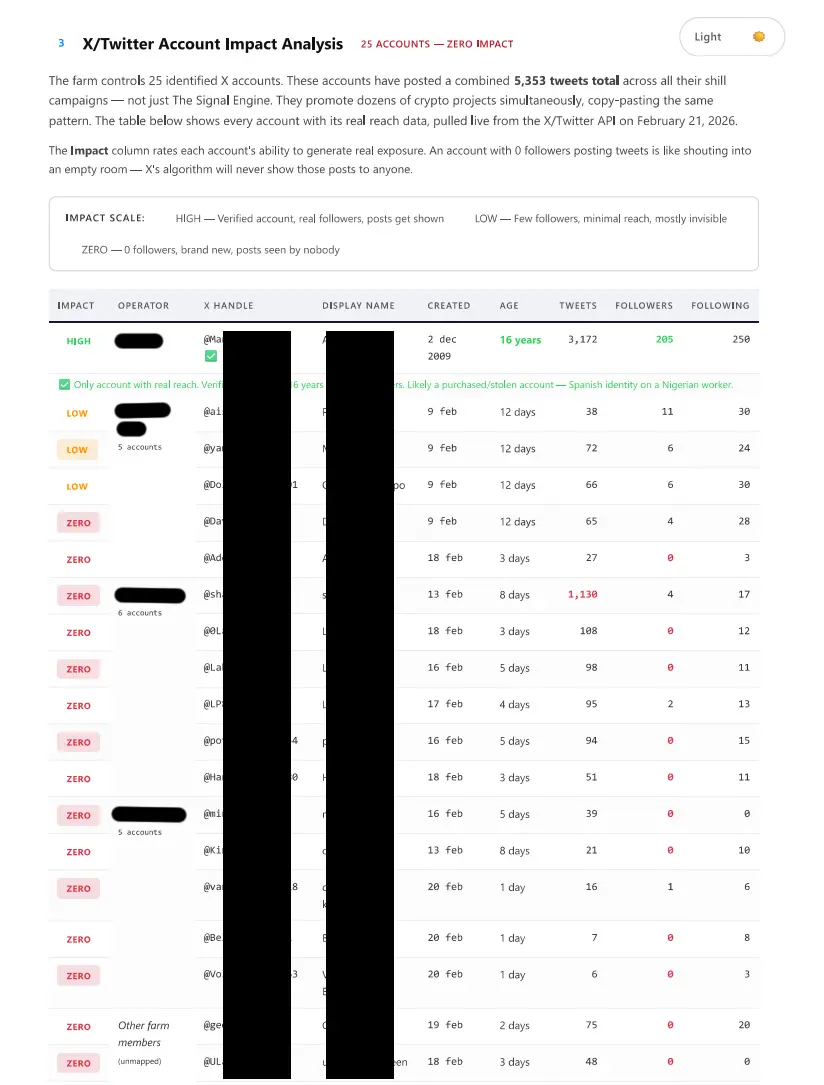
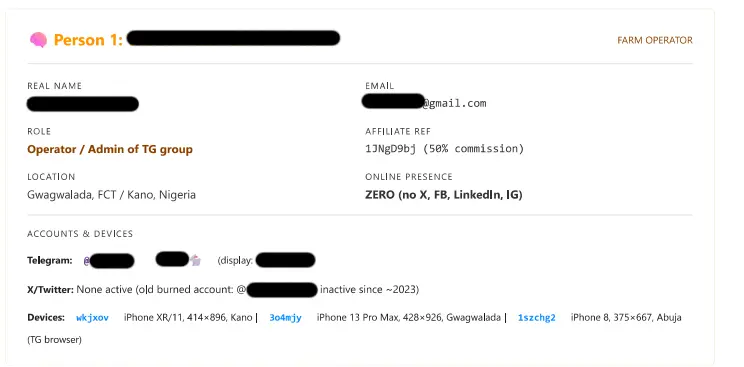
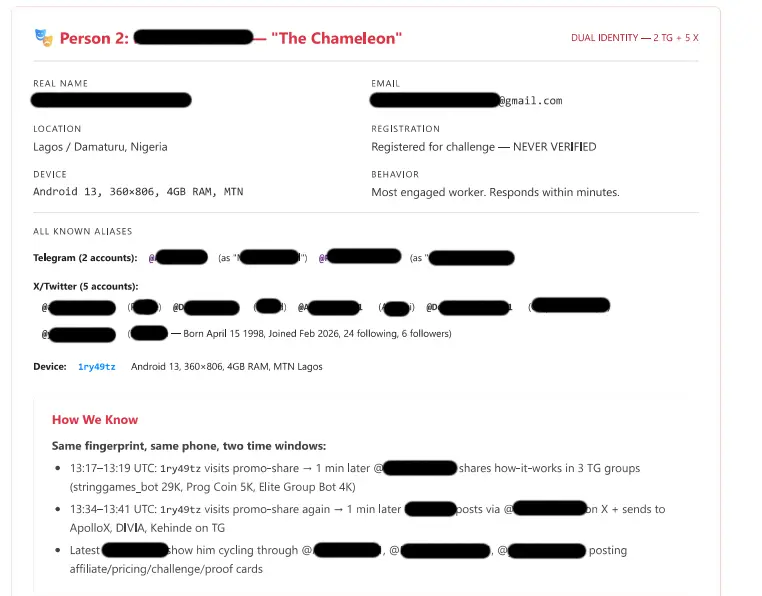
Every identity. Every device. Every alias. Mapped from a single page visit and correlated against social media activity in real time.
It was always an instrumentation test. The marketing was just the cover story.
11. The Exposure
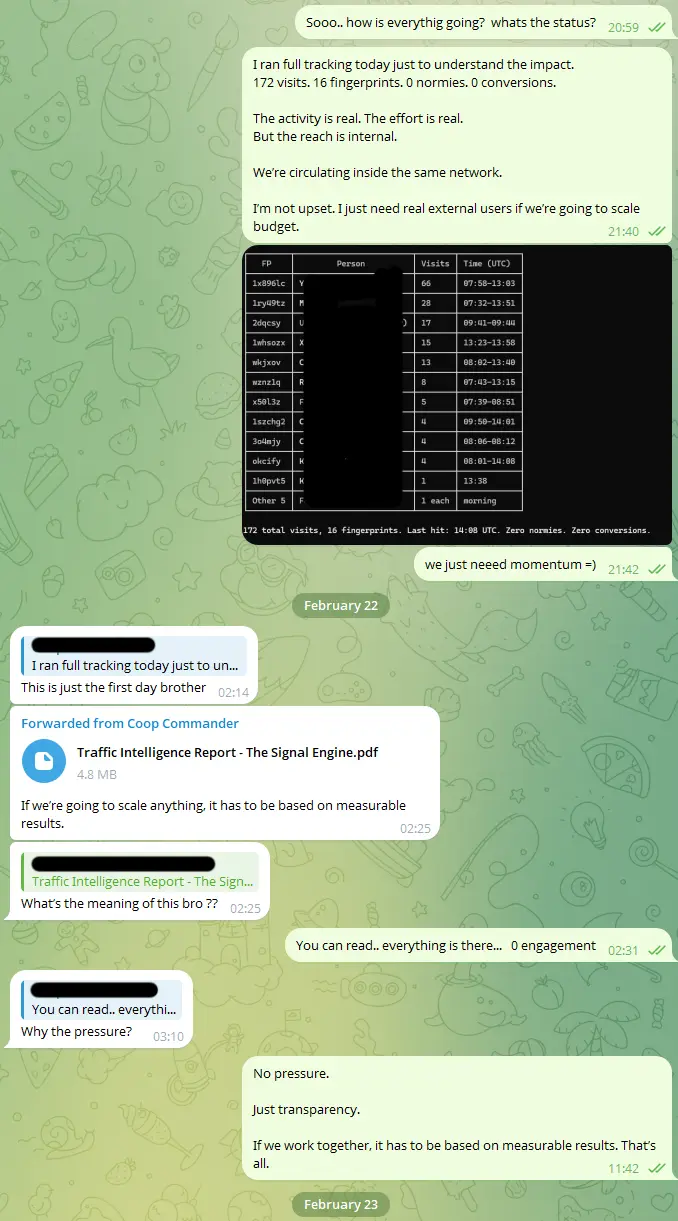
We compiled the full Traffic Intelligence Report and sent it directly to the promoter.
172 visits. 16 fingerprints. 0 normies. 0 conversions.
The activity is real. The effort is real.
But the reach is internal.
We're circulating inside the same network." Us, 21:40
His response came hours later:
We sent the report. A 4.8 MB PDF containing every finding.
Just transparency.
If we work together, it has to be based on measurable results. That's all." 11:42
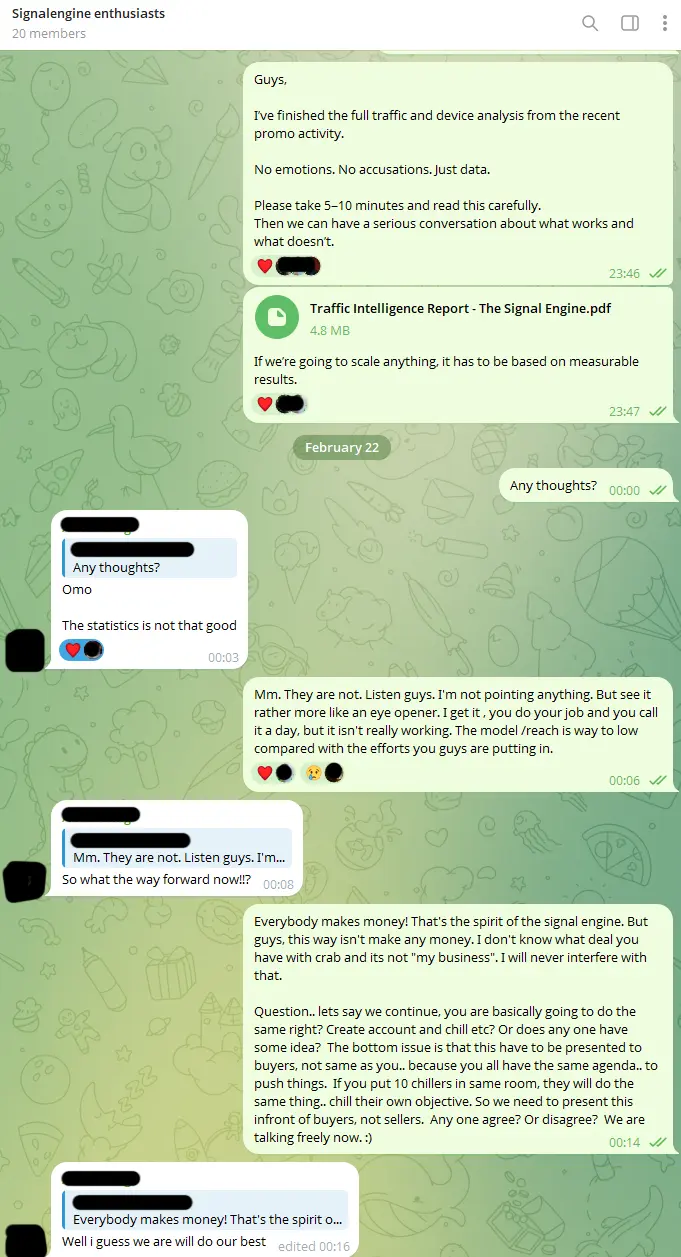
Then we posted the same report in the "Signalengine Enthusiasts" group. All 20 members.
I've finished the full traffic and device analysis from the recent promo activity.
No emotions. No accusations. Just data.
Please take 5-10 minutes and read this carefully.
Then we can have a serious conversation about what works and what doesn't." Us, 23:46
One person responded:
We tried to have an honest conversation about it:
And then, crickets.
No more posts. No more tweets. No more shilling. The group that had generated 2,000+ tweets in a single burst went completely quiet the moment the data was presented. The combination of being measured and being shown those measurements was, apparently, enough.
The activity didn't slow down. It stopped. Turns out, performance becomes uncomfortable when it's visible.
12. The Question That Built Something
The silence after the exposure was louder than 2,000 tweets.
And in that silence, a different question came up. Bigger than this promoter or this group. About the whole system.
Real people spent real hours and real effort producing zero economic value. Not lazy people. Just people with no feedback loop, no data, no guidance. The only instruction they ever got was "post more" and hope something sticks.
What if there was actual guidance?
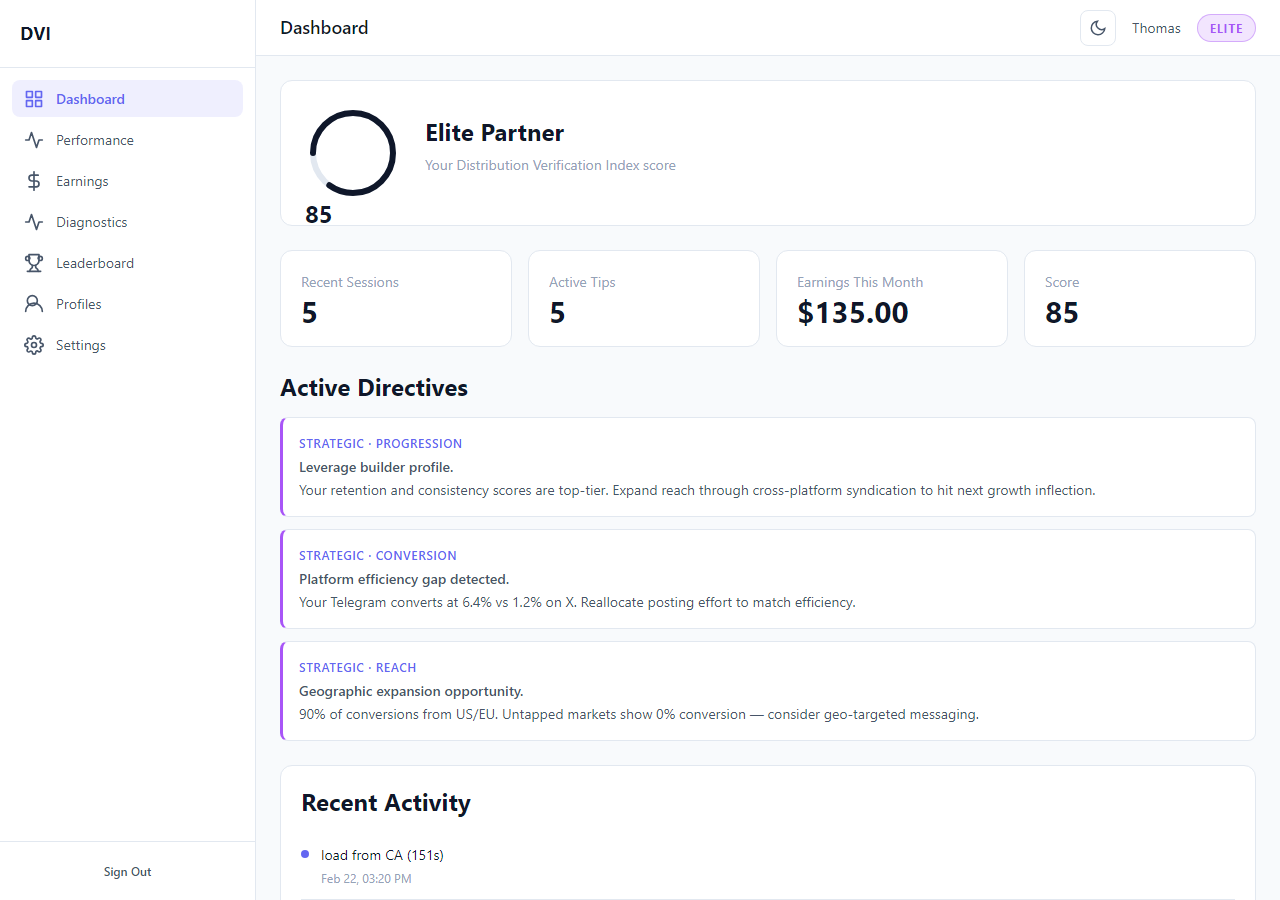
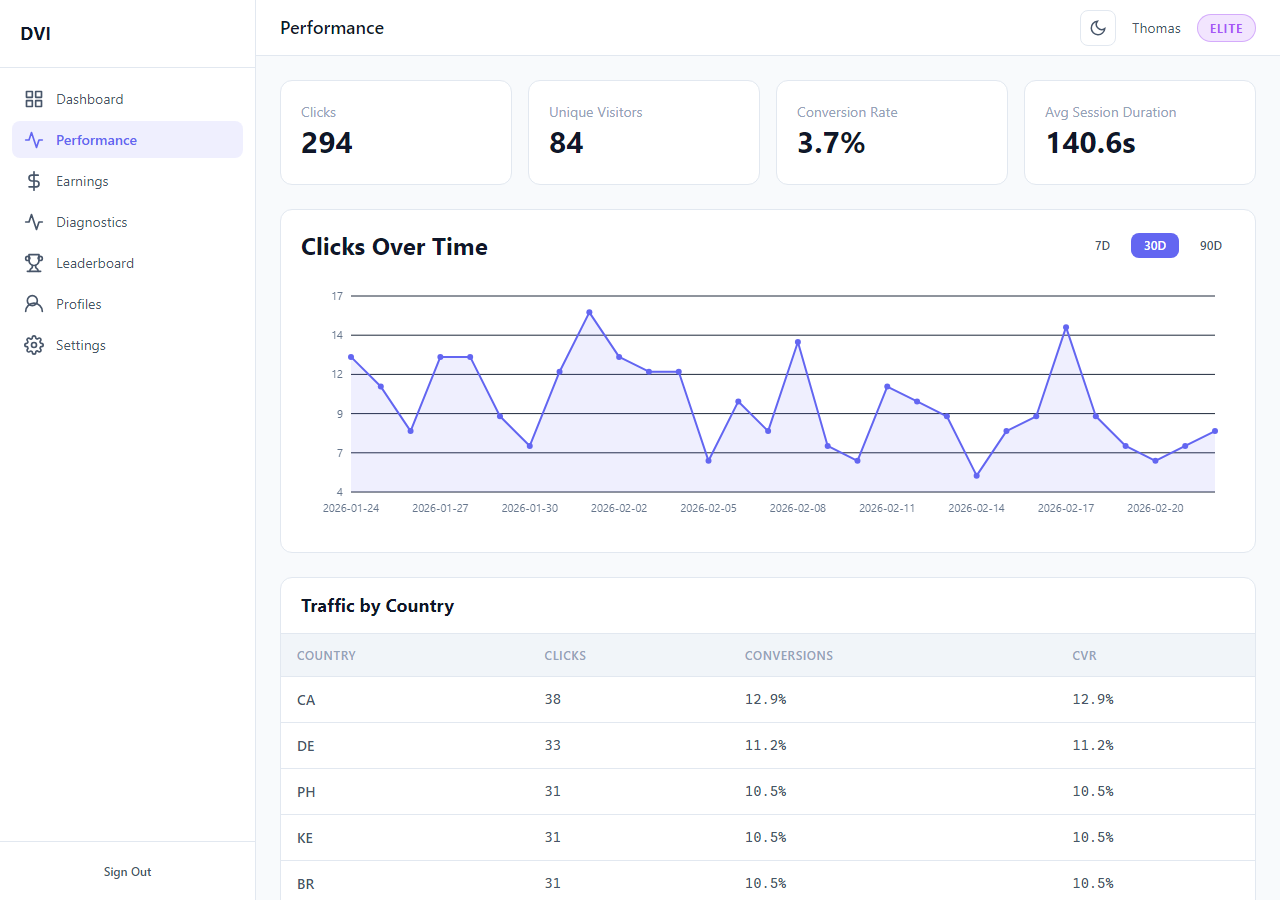
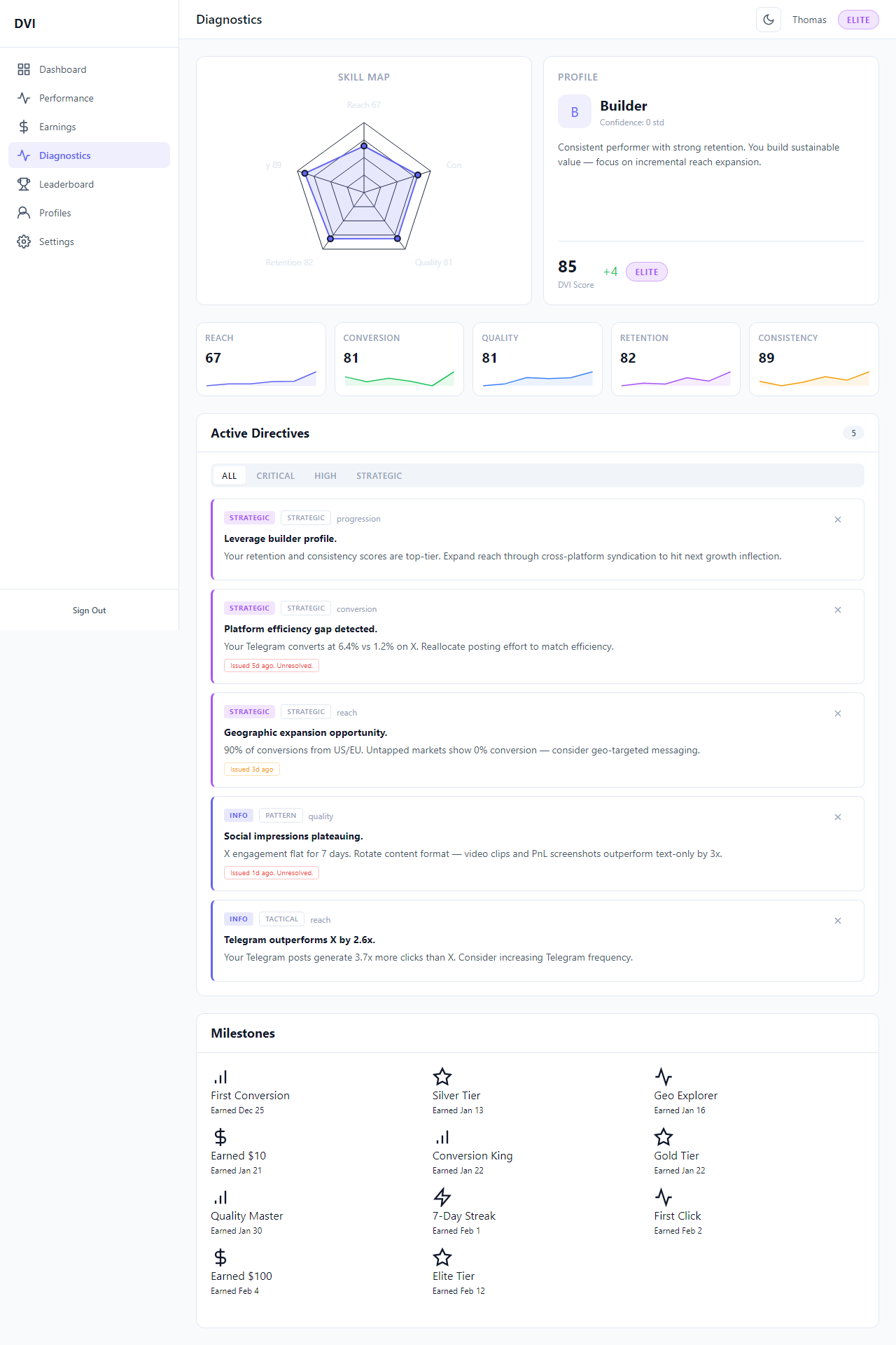
A system that tracks which channels actually work. That tells you in real time: "Your Telegram links generated 3x more visitors than your X account. Try shifting effort there."
Not surveillance. Coaching.
That question led to DVI (Distribution Verification Infrastructure).
A partner intelligence portal where every affiliate gets scored across five axes (Reach, Conversion, Quality, Retention, Consistency) and receives coaching directives based on what their data actually shows.
Instead of "post more and hope," DVI tells you exactly what's working:
DVI is still in development. Maybe the market needs something like this. Maybe it prefers to keep shooting arrows with manpower and hoping something sticks. We'll see.
13. The Broader Implication
This is a pattern. A well-established one.
And this is just the surface. What we documented here was a small operation. 6 people, $110, a Telegram group. There are networks out there operating at scales that make this look like a rounding error. Dozens of groups, hundreds of accounts, budgets that would surprise you.
The thing is, this doesn't only hurt projects. It hurts honest people too.
People who genuinely want to work in web3 get pulled into "chilling groups" because that's the only visible path to income. Companies trying to do a real token launch with actual purpose hire these networks because the alternative looks like invisibility. Builders mistake manufactured engagement for real traction and make decisions based on ghost data.
There's genuine community energy in crypto. Real enthusiasm, real culture, real creativity. But the ideologies keep getting blurred in favor of a few quick dollars. The line between organic momentum and manufactured noise has become almost invisible.
Visibility is interpreted as validation.
Validation is interpreted as growth.
Growth is interpreted as legitimacy.
But economic signal was never present.
Until distribution is evaluated by economic result rather than engagement density, organized clusters will continue to manufacture perceived momentum. And perceived momentum will continue to mislead.
The question is not whether this happens. Everyone in crypto knows it does.
Either we build tools that make the difference visible, or we keep pretending that retweet counts mean something.
Performative distribution, when measured economically, is indistinguishable from absence.
We know, because we measured it. And then we started building something about it.
This analysis was conducted using The Signal Engine's tracking infrastructure.
Device identities confirmed via fingerprint correlation (canvas, audio, font, math signals).
DVI (Distribution Verification Infrastructure) is in active development at dvi.thesignalengine.app.